
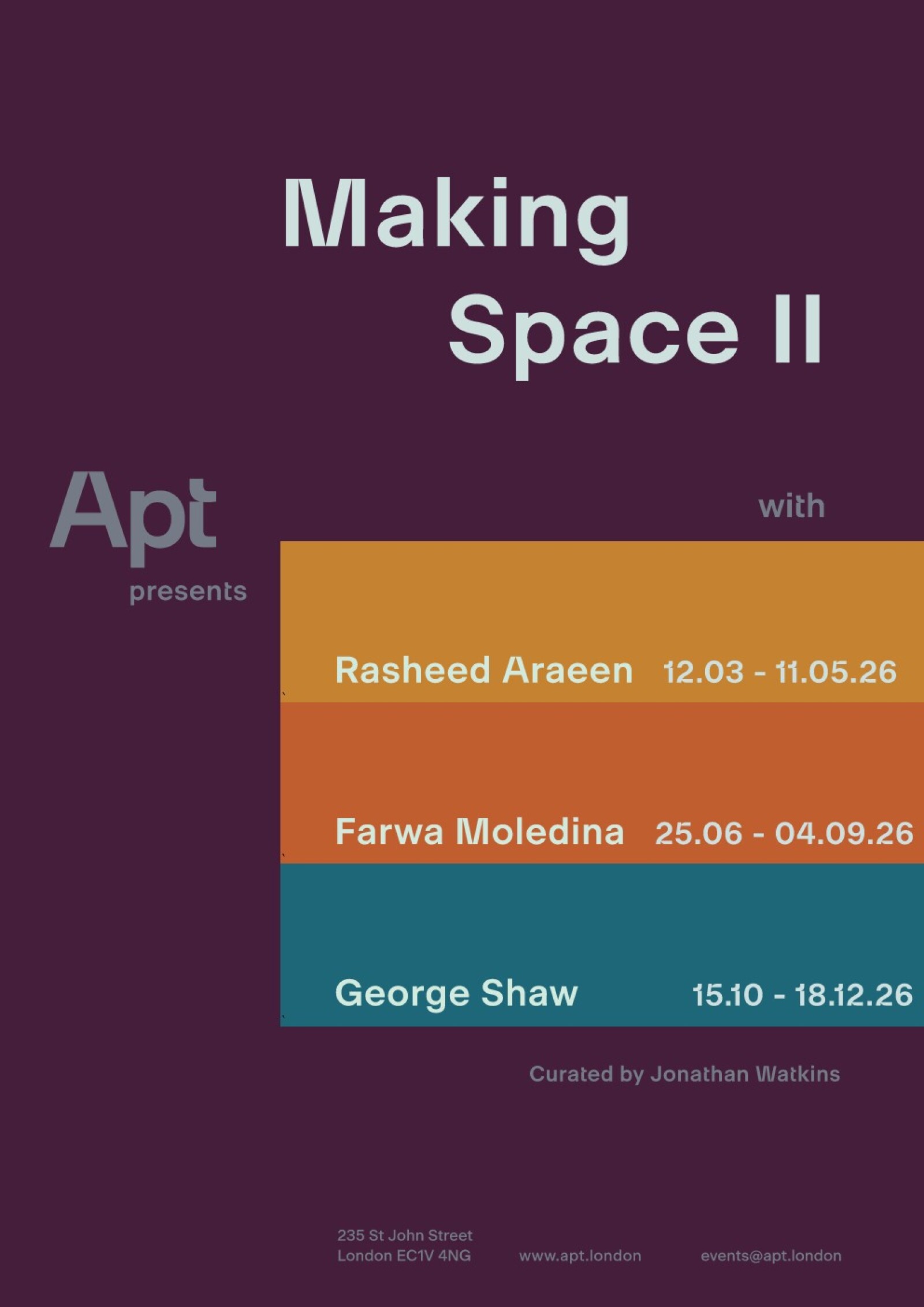


Making Space II
Making Space II is a programme of contemporary art, curated by Jonathan Watkins for the Studio space of Apt architects, St John Street, London. Comprising three solo exhibitions of work by British artists who have a strong interest in the nature of architecture – Rasheed Araeen, Farwa Moledina and George Shaw - it conveys distinct propositions of how space is made, through both representation and process. At the same time, it demonstrates a vital collaborative impulse, as Apt literally is making space on its own premises for art.
A notable feature of the 2026 programme is the extent to which it engages the Apt team, involving them in the design and production of each exhibition. This is made clear immediately in Rasheed Araeen’s exhibition, featuring his seminal From Zero to Infinity, a work conceived in 1968, first shown at Tate Modern in 2004 and, subsequently, many times internationally.
The work begins in a “zero” state of “static energy”, on this occasion in a grid of coloured open cubes, 60 x 60 cm, 6 x 6, laid on the floor. This square, symmetrical format will be then broken by the activity of those who encounter the work, invited to move the cubes around, off the floor, on top of each other, towards an infinity of possible rearrangements. Araeen, an artist who studied engineering, is especially interested to see how architects respond to his relational proposition, and a workshop with him and those at Apt is planned.
The modular nature of From Zero to Infinity, betrays not only Araeen’s professional origins, informed by a globalised modernism, but also the Islamic culture of his upbringing in Pakistan. Such repetition and regularity also characterises the work of Farwa Moledina, a young Birmingham-based artist of Yemini-Tanzanian heritage, born and brought up in Dubai. Drawing on cross-cultural influences, including those personal to her, she is concerned especially to deconstruct Orientalist tropes that undermine the status of women. In response to the architectural context of Apt, she will create a majlis – a low sitting room in Arab and Muslim households – upholstered with patterned fabrics. At first glance it will appear decorative, even opulent, but on closer inspection, the patterns reveal themselves to be combinations of imagery and text that Moledina has made to challenge conventional social narratives.
Entitled A Reading Room, it will be a place not only for leafing through books on Islamic culture and Orientalism, corresponding to Moledina’s practice overall, but also embroidery. There will be a selection of materials for visitors, as well as Apt staff members, to sew onto a shared piece of fabric, thus making marks to signify their presence and varied responses to the exhibition.
George Shaw’s work, by contrast, does not involve audience participation. Comprising paintings on board and framed watercolours, it will require walls and/or screens which the existing Studio space lacks, and so an exhibition design is called for. Shaw will work closely with an Apt architect to make a partitioned interior that enables a smart presentation of his work, in some way playing off its subject matter.
Shaw is renowned for his scenes of Tile Hill, the Coventry suburb where he grew up. This is a post-war built environment, mainly residential and unglamorous. Pubs and football fields, graveyards, houses and garages are painted with unashamed nostalgia, and a carefulness that conveys the artist’s conviction that they are eminently worthy of our attention.
I get perturbed by people who have meaningful epiphanies in expensive places – who go to India, Goa, New Zealand, watch a glorious sunset to find themselves. If you can’t find yourself in your own back yard, you’re not going to find yourself in the Serengeti, are you? So for me, it was taking those cliches of epiphany and the sublime and putting them in a place where great thoughts aren’t rumoured to happen.
Architects, like artists, can find inspiration anywhere, usually in places that have been shaped in some way by other architects. Shaw is reminding us that human lives are, in turn, shaped by architecture.
January 2026
Share
